| Brake noise is your car’s direct communication. Different sounds mean different problems — some minor, some needing immediate attention. This guide identifies which sound you have and what it means. |
Every Indian car driver has encountered brake noise at some point. The squeal when braking at a signal. The grinding sound on a firm stop. The occasional chirp when reversing. Most drivers do what I did initially: learn to ignore it and hope it goes away. That is the wrong approach — not because every brake noise is dangerous, but because ignoring the wrong one at the wrong time is genuinely risky. The good news is that brake noise is almost always diagnosable from the sound character alone.
Quick Diagnosis — Which Sound Is Which
| Sound Type | When It Occurs | Most Likely Cause | Urgency |
| High-pitched squeal | During normal braking | Wear indicator touching disc | HIGH — replace pads soon |
| Metal grinding | During any braking | Pads fully worn, metal contact | IMMEDIATE — stop driving |
| Morning squeal only | First 1-2 stops then gone | Surface rust on disc | None — completely normal |
| Low rumble or pulsation | Braking from speed | Warped brake disc | HIGH — safety issue |
| Clicking each application | Every brake use | Loose caliper hardware | Medium — fix at service |
| Scraping when reversing | Reverse only | Debris between pad and disc | Low — usually self-clearing |
Cause 1 — Wear Indicator Squeal — Replace Soon
Modern brake pads have a built-in metal wear indicator tab designed to squeal against the disc when pad material reaches minimum safe thickness. This squeal is not a defect — it is a designed warning system telling you to replace pads within the next 1,000-2,000 km. In Indian stop-start city traffic, brake pads wear every 25,000-35,000 km versus 45,000-60,000 km on highway-dominant routes. When you hear this continuous squeal during braking, book service within two weeks.
Cost 2026: Front pads: Rs. 1,200-2,800 | Rear pads: Rs. 1,000-2,200 | Labour: Rs. 400-800
Cause 2 — Metal-on-Metal Grinding — Stop Driving Today
If wear indicator squeal is ignored, pad material wears through completely and metal backing contacts the disc directly. Harsh, continuous grinding during any braking. By this point braking efficiency is severely compromised and the disc itself is being damaged with every stop. Metal-to-metal contact causes disc damage costing Rs. 4,000-12,000 — entirely avoidable if the wear indicator squeal had been addressed 2,000 km earlier. Do not drive to work and back before addressing this.
Cost 2026: Pads plus disc resurfacing if salvageable: Rs. 4,000-7,000 | Pads plus new disc: Rs. 6,000-15,000
Cause 3 — Morning Squeal That Disappears — Normal
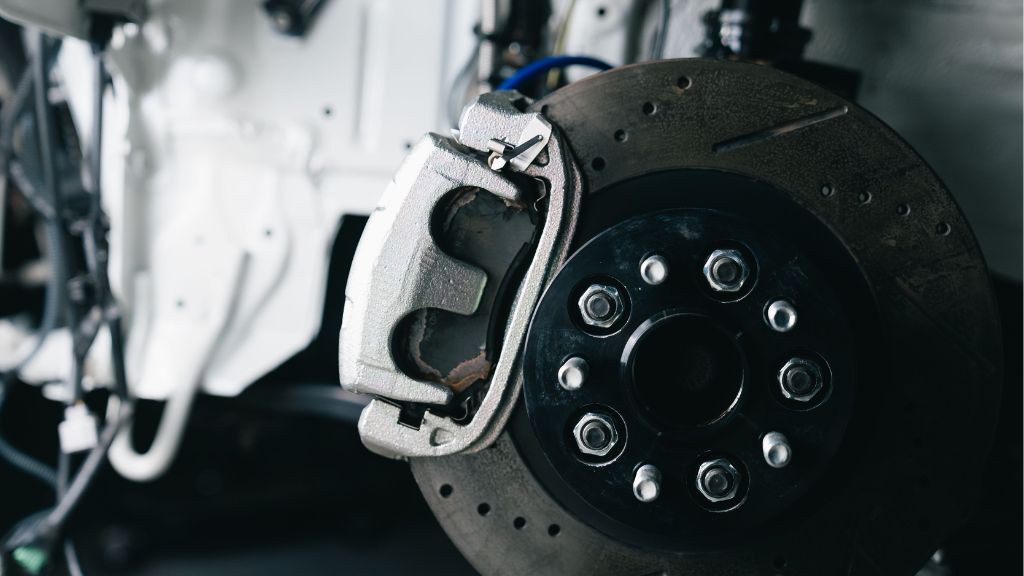
Brakes squeal only on the first 1-2 applications after overnight parking, then gone completely within the first kilometre — this is normal. Surface rust forms on discs when the car sits unused, particularly in humid Indian conditions or after rain. First brake applications scrub this off producing brief squeal. No maintenance required. The distinction from wear indicator noise: morning squeal disappears within 2-3 applications. Wear indicator squeal persists through all driving.
Cause 4 — Low Rumble or Pedal Pulsation — Safety Issue
A low-frequency rumble or pulsating sensation through the brake pedal when braking from speed indicates warped brake discs. Discs warp when they overheat and cool unevenly — after long downhill sustained braking, washing hot discs with cold water, or extended high-speed braking in Indian highway conditions. Warped disc creates uneven braking force — car may pull slightly to one side and pedal pulsates at a rhythm corresponding to wheel rotation speed. This affects emergency stop predictability and should be addressed promptly.
Cost 2026: Disc resurfacing if thick enough: Rs. 500-1,000 per disc | Disc replacement: Rs. 1,500-4,000 per disc
| Also Read: Car AC Not Cooling India 2026 | |
Cause 5 — Clicking Sound — Service Soon
A clicking noise with each brake application — distinct from squealing or grinding — typically indicates loose brake caliper hardware. The caliper is held by bolts, springs, and anti-rattle clips. If any loosen or wear, the caliper moves slightly each application producing a click. Not immediately dangerous but a maintenance item worth addressing at next service. Specifically ask: check caliper bolts and anti-rattle clips.
Cost 2026: Anti-rattle clip replacement: Rs. 400-1,200 | Caliper bolt replacement: Rs. 200-600
Cause 6 — Scraping When Reversing — Usually Self-Clearing
Scraping specifically in reverse that does not occur going forward typically means debris trapped between pad and disc. In Indian conditions — dust, gravel, construction material — small particles occasionally lodge against the disc surface. A few moderate braking applications while moving forward usually dislodges it. If it persists beyond 2-3 days of normal driving, have a mechanic inspect — debris can occasionally embed in pad material requiring cleaning.
When to Stop Driving Immediately
- Metal-on-metal grinding during any braking — drive carefully to nearest workshop only
- Brake pedal goes to the floor — brake fluid loss or master cylinder failure — call roadside assistance
- Strong pull to one side when braking — caliper seizure — get off road safely and call service
- Burning smell combined with brake noise after long downhill — overheated brakes — stop and let cool before continuing
Frequently Asked Questions
Q: Why do car brakes squeal in India?
Most common causes: worn pads triggering the metal wear indicator (high-pitched squeal, continuous during braking — replace pads within 2 weeks), surface rust on discs after overnight parking (disappears after 2-3 stops — completely normal), warped discs from heat (rumbling pulsation — safety concern, fix promptly). These three account for over 85% of brake noise complaints from Indian car owners.
Q: How often should brake pads be replaced India?
City driving with stop-start traffic: every 25,000-35,000 km. Highway-dominant driving: 40,000-60,000 km. The wear indicator squeal triggers at approximately 2-3mm remaining pad thickness. When you hear it, replacement needed within 1,000-2,000 km. Never ignore for more than two weeks.
Q: Does brake noise affect insurance claims India?
Brake noise itself does not affect claims. However, if an accident investigation reveals obviously neglected brakes — pads fully worn, grinding evident — insurers may use this to dispute or reduce a claim on grounds of improper vehicle maintenance. Maintaining brakes in serviceable condition is both a safety requirement and an insurance compliance matter.